
Breakouts after the gym. Redness that won’t settle. Skin that feels angry by mid-afternoon even though your morning routine was fine. For a lot of people, the missing variable turns out to be surprisingly simple – and surprisingly cheap.
Hypochlorous acid spray, or HOCl, has quietly become one of the most talked-about skincare ingredients on Reddit, TikTok, and in dermatology offices. Not because it promises to resurface your skin or reverse the clock — but because it fits almost every moment of your day, in a way that most skincare ingredients simply don’t.
Hypochlorous acid spray, or HOCl, has quietly become one of the most talked-about skincare ingredients on Reddit, TikTok, and in dermatology offices. Not because it promises to resurface your skin or reverse the clock — but because it fits almost every moment of your day, in a way that most skincare ingredients simply don’t.
Key Takeaways
- HOCl goes after cleanser, before serum and moisturizer - think of it as your toner step
- Gentle enough for daily use, including sensitive, dry, acne-prone, and reactive skin
- Works best when used across multiple moments in your day, not just morning and night
- Always let it air dry before layering anything else on top
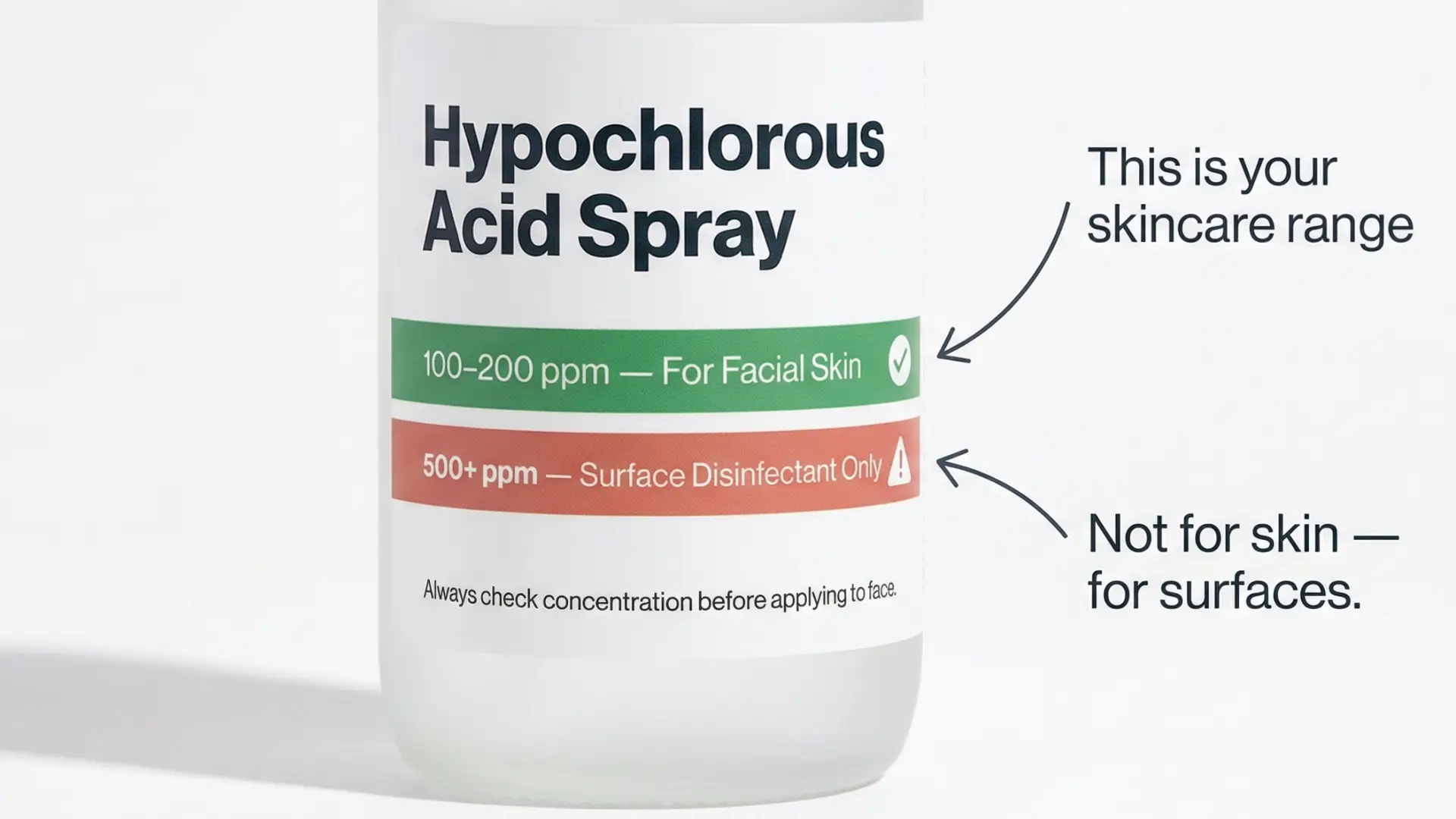
- Stick to products formulated at 100–200 ppm for facial use — higher concentrations are for surfaces, not skin
- Not remotely the same as bleach — it's a weak acid your own white blood cells produce naturally

What Is Hypochlorous Acid, Exactly?
Your immune system already makes this. When you get a cut or an infection, white blood cells release hypochlorous acid as part of your innate immune response — it kills bacteria, reduces inflammation, and helps tissue heal without damaging the healthy cells around it.
In skincare, scientists replicate that same molecule using electrolysis : running a low electrical current through a salt-and-water solution. The result is chemically identical to what your body produces. That’s a big part of why it tends to be so well-tolerated — your skin already recognises it.
Dermatologists have used HOCl in wound care, post-laser recovery, and treatment of conditions like blepharitis for years. Its move into everyday facial sprays and toners is relatively recent, but the science behind it isn’t new.
In skincare, scientists replicate that same molecule using electrolysis : running a low electrical current through a salt-and-water solution. The result is chemically identical to what your body produces. That’s a big part of why it tends to be so well-tolerated — your skin already recognises it.
Dermatologists have used HOCl in wound care, post-laser recovery, and treatment of conditions like blepharitis for years. Its move into everyday facial sprays and toners is relatively recent, but the science behind it isn’t new.
Why It's Worth Adding to Your Routine?
A lot of skincare ingredients do one thing well. HOCl does several, without the trade-offs.
It’s antimicrobial — it targets acne-causing bacteria on the skin’s surface. It’s anti-inflammatory — which means it can calm redness, soothe eczema flare-ups, and take the edge off rosacea. And unlike prescription antibiotics or harsh actives, bacteria don’t develop resistance to it over time.
Compare that to bleach. Sodium hypochlorite — the active ingredient in household bleach — is classified in safety data sheets as a corrosive substance that causes severe skin burns and serious eye damage. HOCl operates at a skin-neutral pH of 5–7. No toxic residue. No harsh chemical smell. Safe for every skin type including reactive, dry, and even post-procedure skin.
It’s antimicrobial — it targets acne-causing bacteria on the skin’s surface. It’s anti-inflammatory — which means it can calm redness, soothe eczema flare-ups, and take the edge off rosacea. And unlike prescription antibiotics or harsh actives, bacteria don’t develop resistance to it over time.
Compare that to bleach. Sodium hypochlorite — the active ingredient in household bleach — is classified in safety data sheets as a corrosive substance that causes severe skin burns and serious eye damage. HOCl operates at a skin-neutral pH of 5–7. No toxic residue. No harsh chemical smell. Safe for every skin type including reactive, dry, and even post-procedure skin.
“It kills bacteria, viruses, and fungi on the skin, which makes it especially useful for conditions like acne, eczema, and rosacea.“
Dr. Ellen Marmur, Dermatologist, Mount Sinai Medical Center
Dr. Ellen Marmur, Dermatologist, Mount Sinai Medical Center

When to Use Hypochlorous Acid Spray - All the Moments That Actually Matter?
Most skincare ingredients come with instructions. Use only at night. Don’t mix with X. Introduce slowly. HOCl is different. It’s flexible in a way that’s rare, and there are more situations in a typical day where it earns its place than you’d probably expect.
Morning - Your Clean Canvas
After cleansing in the morning, mist HOCl onto clean, dry skin and let it air dry. That’s it. It clears residual bacteria, calms any overnight inflammation, and creates a balanced surface before your serum and moisturizer go on.
For acne-prone skin especially, starting the day on a bacteria-free surface means everything else in your routine can actually do its job.
Before Makeup - The Step Most People Skip
Brushes, sponges, fingertips — they all transfer bacteria to your face before foundation even touches your skin. A quick spritz of hypochlorous acid spray before applying makeup sanitises the surface and may reduce the risk of post-makeup breakouts, particularly for acne-prone skin types.
Most people don’t think to do this. Worth trying if maskne or congestion after makeup is a recurring issue.
Pre-Gym - Get Ahead of It
Exercise opens pores and raises skin temperature. That’s also a window for bacteria to cause problems. Misting HOCl before a workout lowers the bacterial load before sweat builds up — a small proactive step that can make a measurable difference if post-gym breakouts are something you regularly deal with.
Post-Workout - The Most Common Use Case
Sweat sitting on skin mixed with surface bacteria. That combination drives a lot of the breakouts people get on their face, chest, and back after exercise — what’s usually called bacne or gym acne.
A few spritzes of HOCl mist immediately after training clears that bacterial buildup and calms any heat-related redness before inflammation has a chance to set in. You don’t need a sink. That’s part of what makes it so practical.
A few spritzes of HOCl mist immediately after training clears that bacterial buildup and calms any heat-related redness before inflammation has a chance to set in. You don’t need a sink. That’s part of what makes it so practical.
After Wearing a Mask
Trapped heat, moisture, friction. Extended mask-wearing creates almost ideal conditions for bacteria – which is why maskne became such a common issue. Applying HOCl spray after removing a mask calms the irritation and addresses the bacterial buildup underneath.
For people who mask for most of the working day – healthcare workers, teachers, commuters – this is one of the most useful applications of a hypochlorous acid spray.
Mid-Day Reset
Between morning and evening, skin picks up a lot — pollution, humidity, oil. A light mist of HOCl mid-afternoon can reset things without disrupting your makeup, and without a full cleansing step. Small habit, noticeable difference over time.
Travel and Long Flights
Recycled cabin air, time zone changes, new climates — travel tends to leave skin in a worse state than usual. HOCl is practical here because it requires nothing: no cotton pad, no sink, just a mist. Soothes irritated and reactive skin on the go, and fits easily in a carry-on.
When a Breakout Appears
At the first sign of a pimple — that deep-set tenderness before anything even surfaces — misting or dabbing HOCl directly on the area can help. Its anti-inflammatory properties reduce the swelling and redness; its antimicrobial action targets the acne-causing bacteria driving the inflammation.
It’s not a replacement for targeted acne treatments like benzoyl peroxide or salicylic acid. But used consistently alongside them, it appears to support clearer skin over time.
It’s not a replacement for targeted acne treatments like benzoyl peroxide or salicylic acid. But used consistently alongside them, it appears to support clearer skin over time.
After Skin Procedures
Microneedling, chemical peels, extractions — any procedure that disrupts the skin surface leaves it sensitised and more vulnerable to bacterial infection. Hypochlorous acid spray is already used in clinical settings post-laser and post-procedure precisely because it promotes healing without the risk of irritating compromised skin.
If your dermatologist recommends a soothing mist during recovery, HOCl is typically what they’re reaching for.
If your dermatologist recommends a soothing mist during recovery, HOCl is typically what they’re reaching for.
Night Routine - Let It Repair
After your evening cleanser, HOCl can calm whatever your skin has been through that day before your night serums and moisturizer go on. For people using strong actives — retinol, exfoliating acids — applying HOCl first may help buffer some of the irritation those ingredients sometimes cause on reactive skin.
Think of it less as an active treatment and more as a reset: calming inflammation, clearing bacteria, letting your skin barrier do its job overnight.
Think of it less as an active treatment and more as a reset: calming inflammation, clearing bacteria, letting your skin barrier do its job overnight.

How to Layer It with Everything Else?
Placement is simple:
- Cleanse
- Mist HOCl — let it fully air dry
- Serum
- Moisturizer
- SPF (morning)
A few combinations worth being thoughtful about:
- Benzoyl peroxide + HOCl — both are antibacterial; using them together may be too much for sensitive skin. Alternate rather than layer.
- Strong exfoliating acids — same logic applies. HOCl before, exfoliants after — or on separate nights.
- Heavily fragranced products — the fragrance can work against HOCl’s calming effect.
Is It Actually Safe to Use Every Day?
Yes — that’s one of the main reasons it’s gained so much traction. Dermatologists generally suggest 1–2 applications daily, but many people use it more frequently across the scenarios above without any issues.
A few things to keep in mind:
- Concentration matters. 100–200 ppm is the appropriate range for facial skincare. Higher concentrations are formulated for surface disinfection — not skin.Higher concentrations are formulated for surface disinfection and hand sanitizing — not skin. If you’re curious whether HOCl works as a hand sanitizer, we’ve covered that separately.
- Packaging matters. HOCl degrades with exposure to light, air, and heat. Opaque, airtight containers stored away from sunlight are what to look for.
- Patch test first if you’re trying a new brand, especially if your skin is particularly reactive.
Frequently Asked Questions
It works best on clean skin, before serums and moisturizer. Mid-day, a light mist over bare skin is fine — it keeps the antibacterial contact intact.
Once or twice daily is the baseline. But given how gentle it is, using it across multiple moments — post-workout, mid-day, after mask removal — is generally well-tolerated.
They share chlorine chemistry, but behave very differently. Bleach is a corrosive, alkaline base. HOCl is a weak acid your immune system makes naturally — pH-balanced for skin and safe at the right concentration.
At appropriate concentrations, yes. Dermatologists use hypochlorous acid to treat blepharitis — eyelid inflammation from bacterial buildup around the lash line. Use a product specifically formulated for facial skin.
Completely different jobs. Hyaluronic acid is a humectant for hydration. HOCl is antimicrobial and anti-inflammatory. Compatible ingredients — use HOCl first, hyaluronic acid after.


