
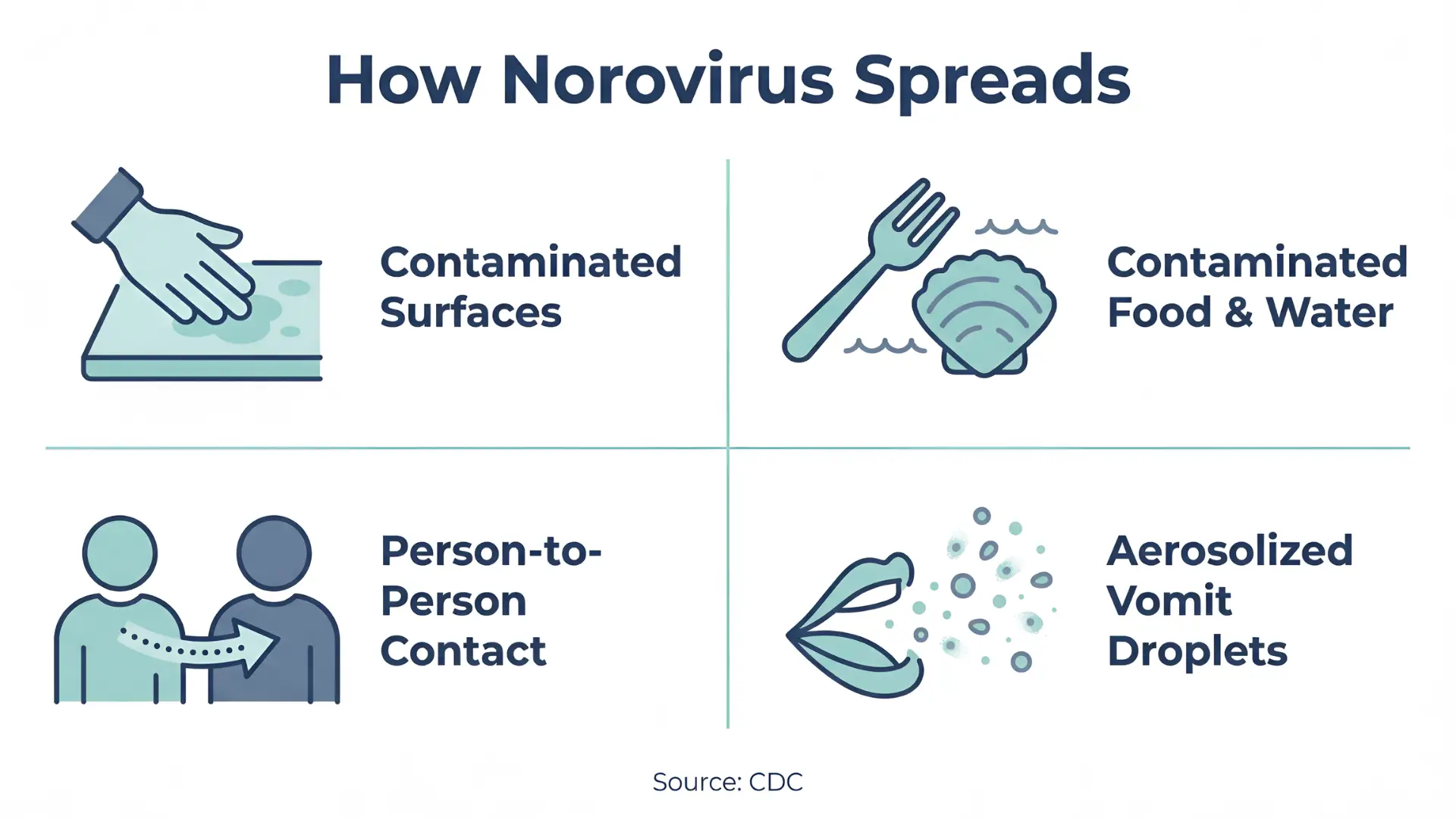
Norovirus is not classified as a true airborne pathogen — but calling it a pure contact virus would be an oversimplification. Research suggests that during a vomiting episode, the virus can briefly become suspended in the air as aerosolized droplets, potentially infecting people nearby. That distinction matters more in practice than most people realize. See what norovirus is.
Key Takeaways
- Norovirus spreads primarily through the fecal-oral route, contaminated food or water, and direct person-to-person contact
- Vomiting can generate aerosolized viral particles — evidence for airborne transmission exists, but it’s situational and short-range
- The infectious dose may be as low as 18 viral particles; an infected person sheds billions
- Alcohol-based hand sanitizer shows limited effectiveness — soap and water is considerably more reliable
- Chlorine-based disinfectants, including hypochlorous acid (HOCl), are among the most effective options for surface decontamination after an outbreak

The Science Behind How Norovirus Spreads
According to the CDC, norovirus is the leading cause of foodborne illness in the U.S., responsible for an estimated 19–21 million cases of acute gastroenteritis every year — including roughly 570–800 deaths, concentrated largely among children and older adults. What makes it so difficult to contain isn’t just the transmission routes. It’s the dose. Studies suggest that as few as 18 viral particles may be enough to establish infection.
Meanwhile, an infected person can shed billions of virus particles through vomit and feces — often before any symptoms appear, which is why norovirus outbreaks tend to be well underway before anyone knows they’ve started.
Meanwhile, an infected person can shed billions of virus particles through vomit and feces — often before any symptoms appear, which is why norovirus outbreaks tend to be well underway before anyone knows they’ve started.
Norovirus can be transmitted through several documented routes:
- Fecal-oral route — the primary pathway
- Contaminated food or water — shellfish and raw produce are frequent vectors in foodborne illness clusters
- Fomites — contaminated surfaces that transfer the virus on contact
- Direct person-to-person contact — especially in environments such as nursing homes, cruise ships, and healthcare facilities

Can Norovirus Actually Become Airborne?
This is where the science gets more nuanced.
A widely cited paper published in Epidemiology & Infection investigated a norovirus outbreak at a UK hotel restaurant. The illness patterns among guests couldn’t be explained by shared food or direct contact alone — the spread was consistent with aerosolized particles generated during a vomiting episode, affecting people in the vicinity who had no other known exposure.
A vomiting episode doesn’t just produce visible contamination. It generates a fine mist of gastrointestinal droplets — bioaerosols — that carry live viral particles into the surrounding air. These aren’t drifting across a building the way measles or SARS-CoV-2 can. But they can linger long enough in the immediate area to be inhaled or settle onto nearby surfaces.
Because working with live norovirus in aerosol experiments is technically challenging, researchers often use bacteriophage MS2 — a harmless, similarly sized virus — as a surrogate. Studies using MS2 have helped map how far these particles travel and how long they remain viable under different environmental conditions.
A vomiting episode doesn’t just produce visible contamination. It generates a fine mist of gastrointestinal droplets — bioaerosols — that carry live viral particles into the surrounding air. These aren’t drifting across a building the way measles or SARS-CoV-2 can. But they can linger long enough in the immediate area to be inhaled or settle onto nearby surfaces.
Because working with live norovirus in aerosol experiments is technically challenging, researchers often use bacteriophage MS2 — a harmless, similarly sized virus — as a surrogate. Studies using MS2 have helped map how far these particles travel and how long they remain viable under different environmental conditions.
The evidence for airborne transmission of norovirus is real, but it’s situational — most relevant within a few feet of a vomiting episode, not something drifting through ventilation systems down a hallway.

Can You Get Norovirus from Flushing the Toilet?
Possibly — and the research here is more unsettling than most people expect.
Studies on what’s called the “toilet plume” show that flushing an open-lid toilet can aerosolize particles from the bowl and project them upward by several feet within seconds. A 2022 study in Physics of Fluids used fluid dynamics modeling to visualize exactly how rapidly that droplet cloud rises and spreads.
Whether norovirus particles in that plume survive long enough in sufficient concentrations to cause infection isn’t fully established. That said, closing the lid before flushing is a well-supported precaution — especially in poorly ventilated bathrooms where aerosolized droplets linger considerably longer.
Whether norovirus particles in that plume survive long enough in sufficient concentrations to cause infection isn’t fully established. That said, closing the lid before flushing is a well-supported precaution — especially in poorly ventilated bathrooms where aerosolized droplets linger considerably longer.
Why Norovirus Outbreaks Are So Hard to Contain?
Cruise ships get disproportionate media attention when it comes to norovirus, but reported norovirus outbreaks in nursing homes and healthcare facilities are actually more frequent — and often more severe given the vulnerability of the populations involved.
Part of the challenge is environmental stability.
Norovirus can survive on hard surfaces for days and resists many of the standard disinfectants used in routine cleaning. Alcohol-based hand sanitizers — the default in most clinical and public settings — show limited effectiveness against norovirus compared to soap and water.
The other part is timing. Because infected individuals begin shedding virus particles before symptoms appear, isolation is rarely implemented before significant spread has already occurred.
Norovirus can survive on hard surfaces for days and resists many of the standard disinfectants used in routine cleaning. Alcohol-based hand sanitizers — the default in most clinical and public settings — show limited effectiveness against norovirus compared to soap and water.
The other part is timing. Because infected individuals begin shedding virus particles before symptoms appear, isolation is rarely implemented before significant spread has already occurred.

What Actually Works Against Norovirus on Surfaces?
The CDC recommends chlorine-based disinfectants for norovirus decontamination — specifically solutions delivering 1,000–5,000 ppm of available chlorine on contaminated hard surfaces.
This is where hypochlorous acid (HOCl) becomes relevant. HOCl is a chlorine-derived compound — produced via electrolysis of salt water and the same molecule white blood cells generate naturally to neutralize pathogens — and it’s EPA-registered against a range of viruses, including norovirus surrogates. Unlike bleach, it operates at a near-neutral pH, making it non-corrosive and safer across a much wider range of surfaces: countertops, bathroom fixtures, door handles, and other high-touch areas that typically need decontamination after an outbreak.
For surface and environmental damage control following a norovirus vomiting episode, it’s a practical, well-supported option. You can read more about how HOCl compares to bleach and whether HOCl is effective against norovirus specifically.
Handwashing with soap and water remains the single most effective step for personal protection — no disinfectant spray replaces that.
For surface and environmental damage control following a norovirus vomiting episode, it’s a practical, well-supported option. You can read more about how HOCl compares to bleach and whether HOCl is effective against norovirus specifically.
Handwashing with soap and water remains the single most effective step for personal protection — no disinfectant spray replaces that.

Preventing the Spread of Norovirus
- Wash your hands with soap and water — after the bathroom, before handling food, and after any contact with an infected person
- Isolate infected individuals as early as possible, especially away from food preparation
- Disinfect surfaces immediately after any vomiting or diarrhea episode
- Stay out of the kitchen while symptomatic, and for at least 48 hours after recovery
- Children and older adults are at higher risk of dehydration — watch fluid intake closely
Treating Norovirus at Home
Most people recover within 1–3 days. The priority is staying hydrated — oral rehydration solutions are more effective than plain water at replenishing electrolytes lost through vomiting and diarrhea. Seek medical attention if symptoms persist beyond 72 hours, if the person is unable to keep any fluids down, or if signs of severe dehydration appear.
Frequently Asked Questions
Not through casual breathing — the risk is specific to being near someone during a vomiting episode, where aerosolized droplets can be inhaled or deposit on nearby surfaces.
Viral particles from a vomiting episode may remain briefly airborne — likely minutes rather than hours. The more persistent risk is particles that settle on surfaces and get transferred later by touch.
Technically droplet — not truly airborne. True airborne pathogens like measles remain suspended over long distances. Norovirus aerosolization is short-range and situational.
Alcohol-based sanitizers show limited effectiveness against norovirus. Soap and water is significantly more reliable, which is why the CDC specifically recommends it over sanitizer for this virus.
Yes — particularly if you avoid proximity during vomiting episodes, maintain consistent hand hygiene, and minimize shared surfaces or utensils.


