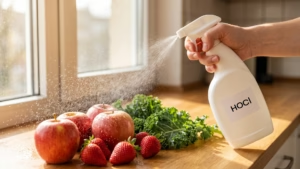
Hypochlorous acid (HOCl) is a weak acid your white blood cells make to fight infection. Manufacturers make it too, by running electricity through salt water. It’s a disinfectant that many people choose over bleach for cleaning surfaces and caring for skin, because it doesn’t come with bleach’s burn and toxic-gas warnings.
Before you buy, though, you need to know how to read the label. Here’s how.
Before you buy, though, you need to know how to read the label. Here’s how.
Key Takeaways
- HOCl is a disinfectant your body makes. White blood cells produce it during an immune response.
- pH matters more than most labels admit. Get it wrong and you end up with bleach-like hypochlorite or chlorine gas.
- Contact time varies by product. The EPA labels I reviewed range from 1 to 10 minutes.
- Shelf life is short. Some labels ask you to use the product within 14 to 30 days of production.
- It isn't a cure-all. Metal surfaces, food areas and skin each have their own rules.
How Does Hypochlorous Acid Work?
Neutrophils are the most common white blood cells, making up roughly 50 to 70% of them in most mammals. They’re also the first immune cells to reach an infection. Inside them, an enzyme turns hydrogen peroxide and chloride into HOCl, which then attacks the microbes the cell has swallowed.
So the body makes hypochlorous acid on demand, in small doses, right where it’s needed. That precision matters. HOCl reacts with proteins, DNA and fats almost instantly, and researchers note it isn’t risk-free for the body’s own tissue.
So the body makes hypochlorous acid on demand, in small doses, right where it’s needed. That precision matters. HOCl reacts with proteins, DNA and fats almost instantly, and researchers note it isn’t risk-free for the body’s own tissue.

How Is HOCl Made? Electrolysed Water and Salt Water
Most commercial HOCl starts as salt water. An electric current splits it, and the result is an antimicrobial solution generated electrolytically from sodium chloride. This is electrolysed water. Our guide on how hypochlorous acid is formed walks through it.
Then pH takes over. Wound-care researchers describe it like this:
- Below pH 3.5: a mix that includes chlorine gas
- pH 3 to 6: mostly HOCl
- Above pH 5.5: sodium hypochlorite starts to form
Below pH 7.5, HOCl is also roughly 80 times more potent as a germ killer than the hypochlorite ion. A well-made product sits in that sweet spot.

Hypochlorous Acid vs. Bleach: Chlorine, Hypochlorite and Safety
Bleach is sodium hypochlorite in alkaline water. Doctors have used sodium hypochlorite on wounds since Dakin’s work in the early twentieth century. But those conventional preparations sit at pH 8.5 to 10 and contain the hypochlorite ion, which is less bactericidal and more toxic to skin repair cells than HOCl.
In one lab comparison, an HOCl formulation showed better antimicrobial activity and a better therapeutic index than both sodium hypochlorite and hydrogen peroxide. That’s a lab result, not a human trial.
The safety data sheets (SDS) I reviewed fill in the hazard side:
In one lab comparison, an HOCl formulation showed better antimicrobial activity and a better therapeutic index than both sodium hypochlorite and hydrogen peroxide. That’s a lab result, not a human trial.
The safety data sheets (SDS) I reviewed fill in the hazard side:
- Sodium hypochlorite (10 to 20% solution): causes severe skin burns and eye damage, and gives off toxic gas on contact with acids.
- NaDCC chlorine tablets: irritate skin and eyes, and can generate nitrogen trichloride when damp.
- Hydrogen peroxide (33%): causes serious eye damage and can intensify a fire.
These are concentrated products, so read them as a worst-case comparison, not a kitchen one. Our HOCl vs bleach breakdown goes deeper.

Does Hypochlorous Acid Kill Viruses?
Yes, if the product is EPA registered for it. Labels list HOCl against cold viruses, coronavirus and norovirus. The wait time is different for each product, from 2 minutes to 10 minutes. That wait is the contact time, and the surface must stay visibly wet the whole time. Wiping early wastes the product. See our post on whether HOCl kills COVID-19 for more.
Where Does HOCl Work Best? Surface Cleaning and Everyday Hygiene
Think hard, non-porous surfaces: counters, door handles, tables. The labels I read share a few rules:
- Clean first. One label says blood and body fluids must be cleaned off before you apply it.
- Watch your metals. Another warns that prolonged contact with metal may cause pitting or discoloration.
- Rinse food surfaces. Some listed products need a post-rinse on food-contact surfaces.
None of this makes HOCl a bad cleaner. It just means “gentle” isn’t the same as “use anywhere.”

Is Hypochlorous Acid Safe? Skin Care and Wound Care
For wounds, the evidence is stronger. A recent study notes that expert recommendations call stabilized HOCl a useful first-line antiseptic for infected wounds. Research formulations are typically made in 0.9% saline, the same salt level as your body fluids.
Skin care is murkier. I could not verify claims about acne or eczema from the sources I reviewed, so ask a dermatologist first. For deep or infected wounds, see a doctor instead of reaching for a spray. Our skin safety guide covers what we can support.
Skin care is murkier. I could not verify claims about acne or eczema from the sources I reviewed, so ask a dermatologist first. For deep or infected wounds, see a doctor instead of reaching for a spray. Our skin safety guide covers what we can support.
Shelf Life and Buying Tips: Choosing a HOCl Spray
Fresh HOCl loses strength. Pure HOCl is hard to keep stable, which is why it has struggled as a drug. One EPA label says use within 14 days or test with a chlorine strip, and not below 450 ppm (parts per million) of free chlorine. Another allows 30 days and lists a 500 ppm minimum at production.
Before buying a spray, check for:
Before buying a spray, check for:
- Concentration in ppm
- A near-neutral pH. Labels I found cite 6.5 to 6.7.
- A production or expiry date
- An EPA registration number, if it claims to disinfect
- A stated contact time
Use skin sprays on skin and cleaners on surfaces. Don’t swap them. For storage, see how to store HOCl. If you want a ready-made option, the 500ml disinfectant spray is one place to start.
Wrapping up
Hypochlorous acid is a chemical your own immune cells already make. A well-made HOCl spray borrows that chemistry for your counters, your high-touch surfaces and your wound care routine, without the burn and toxic-gas warnings that sit on the bleach data sheet.
That’s why more homes, clinics and care settings are switching over. And the label makes the choice easy. Look for a stated ppm, a near-neutral pH, a production date and a clear contact time, and you’re looking at a product built properly. Ready to try it? Start with one job, like surface cleaning, using our 500ml disinfectant spray. Or browse the full HOCl Hub range to find the right fit.
That’s why more homes, clinics and care settings are switching over. And the label makes the choice easy. Look for a stated ppm, a near-neutral pH, a production date and a clear contact time, and you’re looking at a product built properly. Ready to try it? Start with one job, like surface cleaning, using our 500ml disinfectant spray. Or browse the full HOCl Hub range to find the right fit.
Frequently Asked Questions
Disinfection, wound care and surface cleaning. Some brands also sell it as a skin spray.
No. Bleach is sodium hypochlorite at a higher pH.
It depends on the product. The labels above range from 14 to 30 days after production.
I could not verify this from my sources. Check your label, especially for food-contact surfaces.
Registered products list specific viruses and contact times. Follow the label.