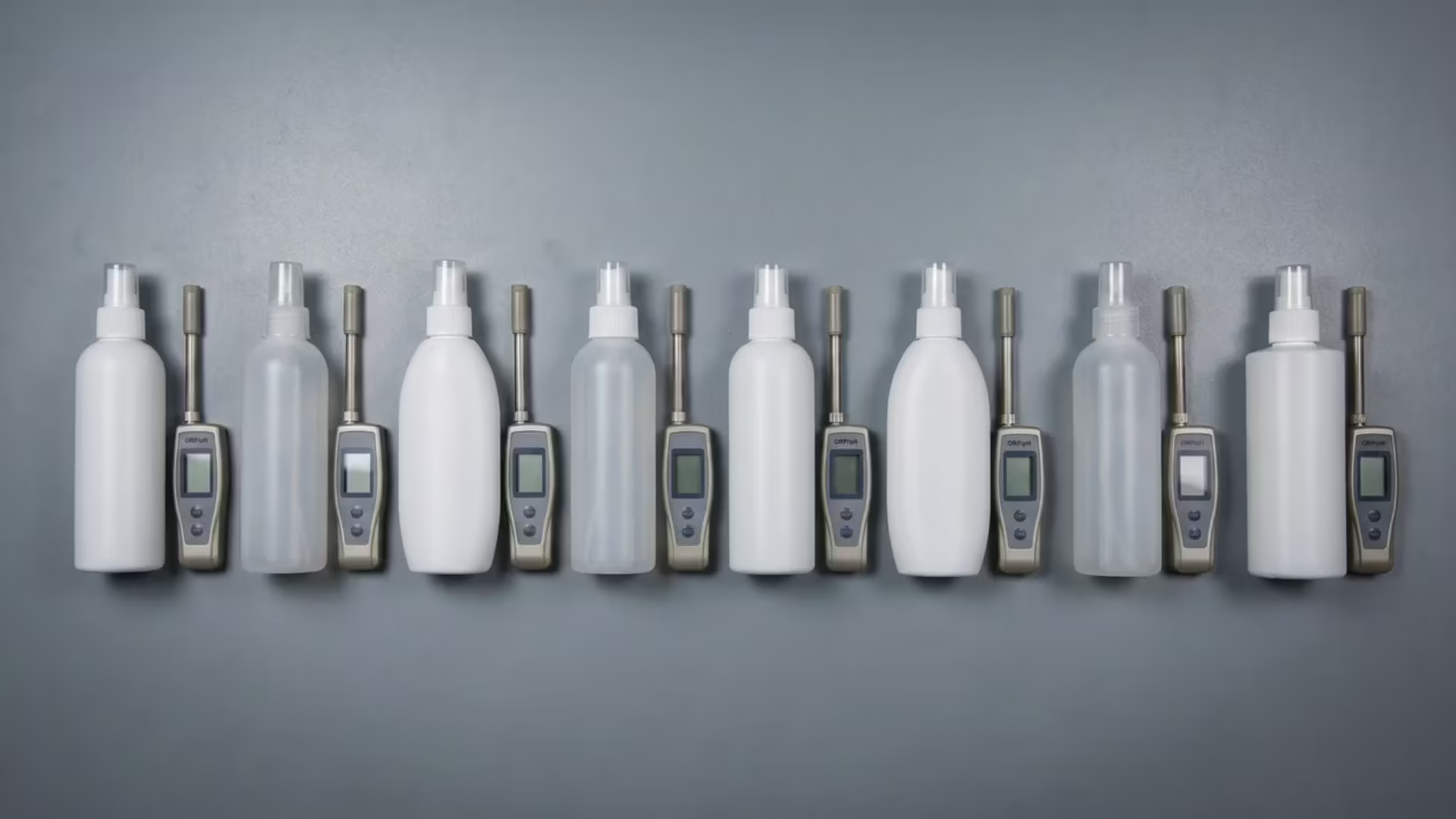
We analysed 8 HOCl products available across the UK, UAE, USA, and Korean markets. What came back was surprising enough that we decided to publish the data. Here’s what we found and what it means before you buy, stock, or launch anything.
What the three metrics actually mean:
01 · FAC
Free Available Chlorine
02 · ORP
Oxidation Reduction Potential
03 · pH
Formulation pH
Want this saved for later?
The Data:
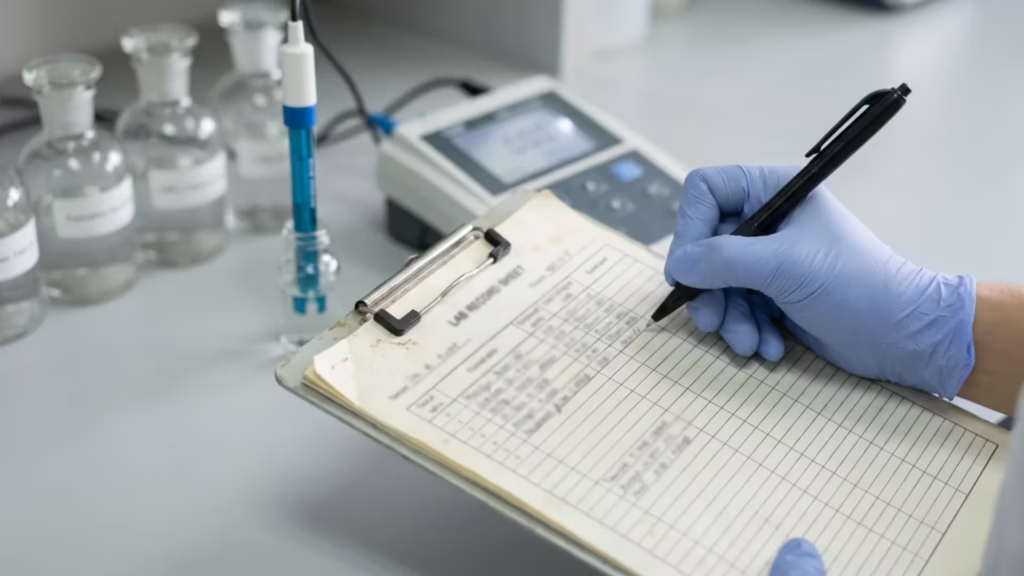
Our own product, Aqua Protego Facial Mist, is included and named for full transparency.
| Product | Origin | FAC (PPM) | pH | ORP (mV) | Odour | Verdict |
|---|---|---|---|---|---|---|
| Product A | UK | 16 | 4.8 | 925 | Faint | Active but limited duration |
| Product B | UK | 22 | 4.1 | 935 | Faint | Active but limited duration |
| Product C | UK | 204 | 5.3 | 932 | Strong Cl | Effective, clinical grade |
| Product D | UK | 185 | 4.5 | 973 | Strong Cl | Effective, clinical grade |
| Product E | Korea | 0 | 5.6 | 402 | Fragrance | Destabilised or depleted |
| Product F | USA | 2 | 4.1 | 418 | Slight unpleasant | Destabilised or depleted |
| ★ Aqua Protego Facial Mist | UAE | 62 | 5.8 | 850 | Mild | Balanced, cosmetic grade |
Products E & F
What the data actually shows?
Destabilised or depleted — Korea & USA
Two products returned ORP readings of 402mV and 418mV, with FAC at 0 and 2 PPM respectively.
At these levels the products are not performing meaningful antimicrobial work. ORP below 650mV is generally considered insufficient for reliable pathogen reduction. FAC at or near zero means the active chlorine has either been fully consumed, degraded on the shelf, or was never present at a meaningful concentration.
The most likely explanation for at least one of these is formulation complexity. One product contains a significant number of additional ingredients alongside hypochlorous acid, including surfactants, humectants, and essential oils.
HOCl is a reactive molecule. Certain additional ingredients actively destabilise it, accelerating degradation and reducing effectiveness. A long ingredient list and HOCl are not natural partners.
The other showed similarly low readings with a slightly unpleasant odour, suggesting possible shelf degradation or substandard production. Proper storage is important for maintaining HOCl stability, so see our guide on how to store HOCl.
Products A & B
Active but limited duration - UK
The oxidising capacity is there. The duration isn’t. On contact with organic matter, the active chlorine will be consumed quickly.
Fine for light-touch applications in clean environments. Not suitable where sustained contact-time efficacy is required. Faint odour makes these cosmetic-appropriate but capacity is the limitation.
Products C & D
Effective but harsh - UK
Genuinely effective by the numbers. High FAC sustains antimicrobial activity over meaningful contact time. Strong ORP confirms active HOCl.
The trade-off is a strong chlorine smell, which limits suitability for cosmetic or skin-contact applications. These are more accurately characterised as clinical or facility-grade HOCl products.
And on the chlorine smell: this is not a negative indicator. A strong chlorine smell is confirmation that HOCl is present and active.
The products in this dataset with the weakest numbers had fragrance or no discernible smell at all. If you’re evaluating an HOCl product and it smells of nothing, that’s worth investigating.

Aqua Protego Facial Mist
Balanced, cosmetic grade - UAE ★
62 PPM FAC is not the highest in this dataset. 850mV ORP is not the highest either. That’s the point.
A cosmetic-grade HOCl product optimised for skin contact does not need to match clinical-grade FAC. It needs to be stable, effective for its intended application, and tolerable in repeated use.
pH 5.8 is a deliberate formulation target, keeping the chlorine in its most active chemical state. The balance between these three numbers is a formulation decision, not a compromise.
Prefer to read this offline?
Three questions to ask before you buy, stock, or launch:
What is the FAC?
If the answer is zero or near-zero, the active chlorine is gone. The product is not performing as HOCl regardless of what the label says.
What is the ORP?
Below 650mV, antimicrobial performance is unreliable. Above 800mV with sufficient FAC, you have a product that can do the work and sustain it.
What is the pH, and is it intentional?
A manufacturer who can tell you their target pH and why they hit it understands their formulation. One who cannot is either reselling without understanding it or hasn't tested properly.
The label says HOCl. The numbers tell you whether it is.
Most people come in with assumptions, then get caught off guard when the numbers don’t match the marketing. Tell us where you’re at, what you’re trying to achieve, and which market you’re operating in. We’ll help you understand what the numbers should look like for your specific application before you commit to anything.