
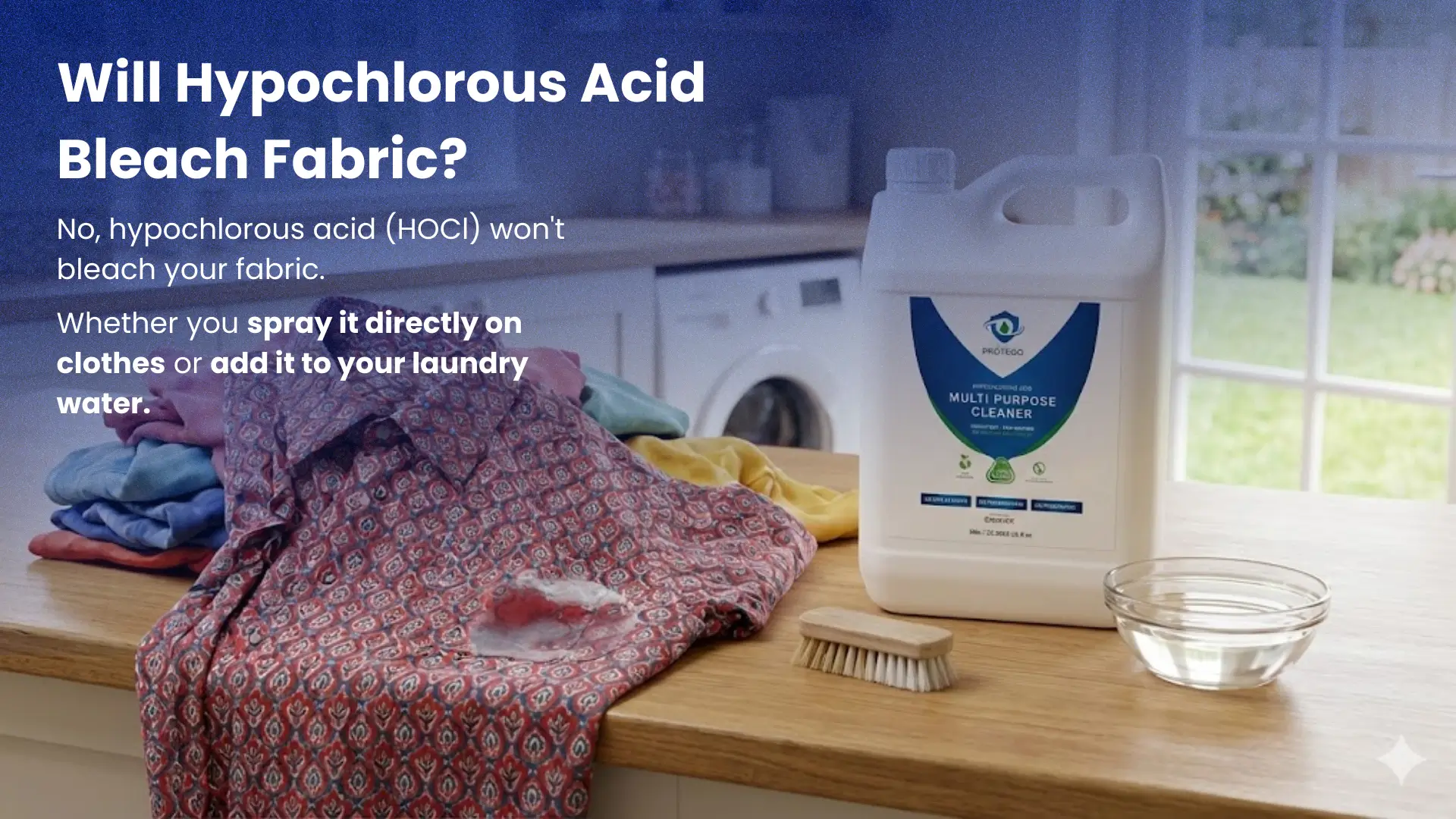
No, hypochlorous acid (HOCl) won’t bleach your fabric whether you spray it directly on clothes or add it to your laundry water. Unlike chlorine bleach that strips color and weakens fibers, HOCl is a weak acid that disinfects without the harsh oxidative bleaching effect.
The confusion appears to stem from the name. When people hear “acid” or see HOCl described as a powerful disinfectant, they naturally worry it might damage clothes like spray bleach does. But the chemistry tells a different story entirely.
Hypochlorous acid is made through electrolysis of salt and water, creating a solution that kills bacteria and viruses without attacking fabric dyes. Your white blood cells produce this same molecule to fight infections, which is why it’s gentle enough for skin care yet powerful enough to sanitize.
The confusion appears to stem from the name. When people hear “acid” or see HOCl described as a powerful disinfectant, they naturally worry it might damage clothes like spray bleach does. But the chemistry tells a different story entirely.
Hypochlorous acid is made through electrolysis of salt and water, creating a solution that kills bacteria and viruses without attacking fabric dyes. Your white blood cells produce this same molecule to fight infections, which is why it’s gentle enough for skin care yet powerful enough to sanitize.
Key Insight: Research shows hypochlorous acid is 80-100 times more effective at killing pathogens than traditional bleach because it works better if not equal at a far lower concentration.
Key Takeaways
- HOCl is fabric-safe and won't bleach, fade, or damage clothing when used properly
- Unlike sodium hypochlorite (Clorox bleach), HOCl has a neutral pH of 5-7 that doesn't oxidize fabric dyes
- Safe alternative to Dettol and bleach for adding to laundry water with no synthetic chemicals or toxic residue
- Works 80-100 times faster than chlorine bleach at killing pathogens without the fabric damage
- Can be sprayed directly on delicate fabrics, upholstery, and colored clothing without causing fading
- Eco-friendly formula breaks down into salt and water after use
Why Hypochlorous Acid Doesn't Bleach Your Clothes?
The reason hypochlorous acid doesn’t bleach fabric comes down to basic chemistry. HOCl operates at a pH between 5 and 7—slightly acidic to neutral—which puts it in a completely different chemical category than sodium hypochlorite bleach.
Chlorine bleach sits at a highly alkaline pH of 11-13. At this extreme alkaline level, the active ingredient is hypochlorite ion (OCl-), a negatively charged molecule that oxidizes organic compounds. This oxidation process is what destroys color pigments in fabric dyes and breaks down textile fibers over time.
Chlorine bleach sits at a highly alkaline pH of 11-13. At this extreme alkaline level, the active ingredient is hypochlorite ion (OCl-), a negatively charged molecule that oxidizes organic compounds. This oxidation process is what destroys color pigments in fabric dyes and breaks down textile fibers over time.
HOCl vs. Bleach: The Critical Differences:
- HOCl: Neutral charge (pH 5-7) → Penetrates bacteria without attacking fabric dyes
- Bleach: Negative charge (pH 11-13) → Oxidizes dyes and bacterial cells indiscriminately
- HOCl: Works at 50-200 ppm concentration → Fabric-safe levels
- Bleach: Requires 12-15% active chlorine → Corrosive to materials
- HOCl: Breaks down into salt and water → No residue
- Bleach: Leaves chlorine compounds → Continues damaging fabric over time
Research published in the Journal of the American Oil Chemists’ Society demonstrated that sodium hypochlorite causes measurable fabric degradation and color removal.
The study showed that bleach treatments reduced fabric breaking strength and altered color values significantly. HOCl works differently. It kills bacteria, viruses, and other pathogens by penetrating their cell membranes and disrupting vital cellular components. This happens because HOCl carries a neutral electrical charge, allowing it to slip through negatively charged bacterial cell walls easily.
The study showed that bleach treatments reduced fabric breaking strength and altered color values significantly. HOCl works differently. It kills bacteria, viruses, and other pathogens by penetrating their cell membranes and disrupting vital cellular components. This happens because HOCl carries a neutral electrical charge, allowing it to slip through negatively charged bacterial cell walls easily.
Your body’s white blood cells produce roughly 2×10⁻⁷ mol of HOCl, which can destroy 150 million E. coli bacteria in milliseconds all without damaging your own tissue.
The same neutral charge that makes HOCl such a powerful disinfectant also explains why it doesn’t attack fabric.
Fabric dyes typically have stable molecular structures that HOCl doesn’t oxidize at the low concentrations used for cleaning (usually 50-200 ppm).
Fabric dyes typically have stable molecular structures that HOCl doesn’t oxidize at the low concentrations used for cleaning (usually 50-200 ppm).

HOCl vs. Chlorine Bleach vs. Dettol: What's Fabric-Safe for Laundry?
Understanding the differences between these common laundry disinfectants reveals why HOCl stands out as the fabric-safe option. While hypochlorous acid and bleach share some chemistry, their pH levels and mechanisms create drastically different results on fabric.
| Feature | Hypochlorous Acid (HOCl) | Chlorine Bleach (NaOCl) | Dettol (Chloroxylenol) |
|---|---|---|---|
| Bleaching Effect | None | Strong oxidative bleaching | None |
| Causes Fading | No | Yes - removes dye pigments | Minimal |
| pH Level | 5-7 (neutral/weak acid) | 11-13 (highly alkaline) | N/A (phenolic compound) |
| Skin Irritation | Non-irritating | Severe burns, eye damage | Moderate irritant |
| Fabric Safety | All fabrics & colors | White/colorfast only | Most fabrics |
| Kill Time | 10-60 seconds | 5-10 minutes | 1-2 minutes |
| Toxic Residue | None (breaks into salt/water) | Corrosive chlorine compounds | Harmful if swallowed |
| Eco-Friendly | Yes - biodegradable | No - environmental pollutant | No - toxic to aquatic life |
| Rinse Required | No | Yes - multiple rinses | Yes |
| Efficacy vs. Pathogens | 80-100x more effective than bleach | Effective but slower | Moderate antimicrobial |
The safety data sheets tell the real story. Sodium hypochlorite (the active ingredient in Clorox bleach) is classified as “Skin Corr. 1B” meaning it causes severe skin burns and eye damage. The SDS for household bleach lists hazards including:
- Corrosive to Metals
- Very toxic to aquatic life with long-lasting effects
- Can liberate toxic gas when in contact with acids
- Causes severe burns to skin and eyes (Eye Dam. 1 classification)
Chloroxylenol (sold as Dettol and PCMX) appears safer than bleach but still carries warnings. According to its material safety data sheet, chloroxylenol causes skin and eye irritation, may trigger allergic reactions, and has an oral LD50 of 3,830 mg/kg in rats—classified as “harmful if swallowed.”
Safety Comparison: HOCl’s safety profile is dramatically different. At proper concentrations for disinfection, it’s non-toxic if accidentally inhaled, ingested, or contacted by skin. The molecule naturally degrades into sodium chloride (table salt) and water, leaving no harsh chemical residue on fabrics or in wastewater. This is why hypochlorous acid is safe for skin contact at the same concentrations that kill dangerous pathogens.
Studies comparing antimicrobial efficacy show that HOCl solutions at pH 4-5.5 demonstrate substantially higher biocidal activity than sodium hypochlorite solutions, while also showing minimal cytotoxic effects on human cells.
Bleach requires much higher concentrations to achieve equivalent germ-killing power, which increases fabric damage risk.
Bleach requires much higher concentrations to achieve equivalent germ-killing power, which increases fabric damage risk.

Adding HOCl to Laundry Water: A Safer Way to Disinfect Clothes Without Bleach
For generations, people have added chemicals like Dettol, Lysol, or diluted bleach to wash water hoping to sanitize their clothes. HOCl offers a genuinely safer alternative that actually works better.
When you add hypochlorous acid to your washing machine, it disinfects without the complications. There’s no need to worry about separating whites from colors, no concern about weakening fabric fibers, and no harsh chemical smell lingering on your clothes.
When you add hypochlorous acid to your washing machine, it disinfects without the complications. There’s no need to worry about separating whites from colors, no concern about weakening fabric fibers, and no harsh chemical smell lingering on your clothes.
Recommended Concentration: The typical concentration for laundry disinfection is 50-200 ppm (parts per million). Most commercial HOCl cleaners and disinfectants come pre-diluted to safe, effective levels.
How to Add HOCl to Your Laundry (Step-by-Step):
- Add clothes to your washing machine as normal
- Pour HOCl solution during the rinse cycle for best results (though it’s gentle enough to add at any stage)
- Use cold or lukewarm water—HOCl works effectively at any temperature, unlike bleach which often requires hot water
- No special rinsing needed—HOCl breaks down into salt and water naturally
- Safe for all colors and fabrics—no need to separate whites from colors
The science backs this up. Research on HOCl’s antimicrobial properties shows it remains highly effective across varying water temperatures. Studies published in Biomedical Research demonstrate that 200 ppm HOCl solutions achieve significant microbial reduction against bacteria, fungi, and viruses within seconds of exposure.
⚠️ Never mix HOCl with other cleaning products, bleach, ammonia-based cleaners, or acidic solutions (vinegar, citric acid). Mixing HOCl with incompatible chemicals can produce toxic chlorine gas, which is dangerous to inhale. Use HOCl alone in your laundry or on surfaces—never combine it with other disinfectants.
What NOT to Do (Bleach Requires Special Handling):
Chlorine bleach, by contrast, requires careful dilution protocols. The CDC’s guidelines for bleach use recommend specific ratios and warn against mixing with other cleaning products due to toxic gas formation risks.
These precautions stem from bleach’s corrosive alkaline nature and chemical instability. Dettol added to laundry water brings its own issues. While it provides some antimicrobial benefit, it contains harsh chemicals that can irritate skin, which are especially problematic for people with sensitivities or children’s clothing.
The phenolic compounds in chloroxylenol don’t rinse away completely, potentially leaving residue that contacts skin all day.
These precautions stem from bleach’s corrosive alkaline nature and chemical instability. Dettol added to laundry water brings its own issues. While it provides some antimicrobial benefit, it contains harsh chemicals that can irritate skin, which are especially problematic for people with sensitivities or children’s clothing.
The phenolic compounds in chloroxylenol don’t rinse away completely, potentially leaving residue that contacts skin all day.
Why HOCl Works Better:
- Sanitizes effectively without separating laundry by color
- Rinses clean (or doesn't even require rinsing)
- Breaks down naturally into harmless components
- No toxic chemical residue on fabric
- Safe for baby clothes, sensitive skin, and delicate fabrics
- Works in any water temperature
You’re essentially using the same germ-killing molecule your immune system produces, just in a convenient spray or liquid form for your laundry.
Spraying HOCl Directly on Fabric and Upholstery
One of HOCl’s most useful applications is spot-treating fabric without washing. You can spray hypochlorous acid directly on clothes, couches, curtains, or any textile surface to sanitize and freshen without bleach damage.
This makes HOCl particularly valuable for items that can’t go in the washing machine. Upholstery, mattresses, car interiors, delicate silk garments al of which can be safely treated.
This makes HOCl particularly valuable for items that can’t go in the washing machine. Upholstery, mattresses, car interiors, delicate silk garments al of which can be safely treated.
How to Spray HOCl on Fabric (Simple 3-Step Process):
- Spray the fabric until lightly misted (don’t oversaturate)
- Let it sit for 30-60 seconds to disinfect and kill germs
- Air dry or blot with a clean cloth (no rinsing required in most cases)
Spot Test Recommendation: For delicate fabrics or expensive items, test a small, hidden area first—not because HOCl is likely to cause problems, but as a general best practice with any new product. If you see no discoloration or texture change after it dries, proceed with confidence.
What You Can Safely Spray with HOCl:
- Delicate silk and wool garments
- Upholstered furniture and sofas
- Mattresses and pillows
- Curtains and drapes
- Car interiors and fabric seats
- Gym bags and athletic gear
- Shoes and boot interiors
- Pet bedding and toys
- Children's stuffed animals
Important Distinction: If a fabric’s dye bleeds with HOCl, it probably bleeds with water too. it’s poor dye quality. High-quality fabrics with proper dye-setting won’t have this issue with either water or HOCl.
Using HOCl as an All-Purpose Fabric and Surface Cleaner
HOCl’s versatility extends beyond just fabric care. The same spray you use to sanitize clothes works equally well on hard surfaces, making it a true all-purpose cleaner.
This dual functionality means you can spray HOCl on your kitchen counters, then use the same bottle to freshen your sofa or disinfect your gym bag. The formula that kills bacteria and viruses on granite countertops is identical to what safely sanitizes your silk blouse.
This dual functionality means you can spray HOCl on your kitchen counters, then use the same bottle to freshen your sofa or disinfect your gym bag. The formula that kills bacteria and viruses on granite countertops is identical to what safely sanitizes your silk blouse.
HOCl Kills These Pathogens in 30-60 Seconds:
- Bacteria: E. coli, Staphylococcus aureus, Pseudomonas aeruginosa, MRSA
- Viruses: Coronavirus (COVID-19), influenza, norovirus, adenovirus
- Fungus: Candida albicans, Aspergillus, mold spores
- Other Pathogens:Biofilm-forming organisms, bacterial spores
Research from PMC/NIH shows HOCl achieves 3 to 5 log reductions (99.9% to 99.999% kill rates) against tested viruses on both surfaces and fabrics within seconds.
How to Use HOCl as an All-Purpose Cleaner:
- Spray and let sit for 30-60 seconds for most pathogens
- For tougher jobs or higher bioburden, extend contact time to 2-3 minutes
- No wiping required for disinfection (though you can if preferred)
- Safe on fabric and hard surfaces without switching products
Critical Storage Guidelines:
Storage Warning: Keep the bottle away from sunlight and tightly sealed when not in use. UV light and air exposure can cause HOCl to break down into chlorine gas and water, reducing its antimicrobial potency. Properly stored hypochlorous acid maintains its shelf life for months, though most manufacturers recommend using it within 6-12 months of opening.
This is another advantage over Clorox bleach, which degrades even faster. Sodium hypochlorite solutions lose roughly 50% of their strength within one year under ideal storage conditions. Heat, light, and contamination accelerate this decomposition significantly.
Frequently Asked Questions
No, HOCl won’t ruin clothes even at higher concentrations used for disinfection. Most commercial HOCl products range from 50-200 ppm, which is safe for all fabric types. Unlike bleach where concentration directly correlates with fabric damage risk, HOCl’s gentle chemistry means it stays fabric-safe across its effective concentration range. That said, using HOCl as directed ensures optimal results. Following manufacturer dilution
guidelines gives you the right balance of antimicrobial power and fabric safety.
Absolutely—and it’s often the better choice. HOCl provides superior disinfection without Dettol’s skin irritation risk or bleach’s fabric-damaging properties. Add it during the rinse cycle or throughout the wash. It works in cold or warm water, doesn’t require extensive rinsing like bleach, and won’t leave chemical residue like phenolic disinfectants. For families with sensitive skin or allergies, switching from Dettol or bleach to HOCl often reduces skin reactions while actually improving sanitization.
No. Research and real-world use demonstrate that HOCl doesn’t cause fading on properly dyed fabrics. The neutral pH and low oxidation potential at cleaning concentrations simply don’t attack color molecules the way alkaline bleach does. Hydrogen peroxide and chlorine bleach both work through aggressive oxidation that breaks down chromophores (color compounds) in dyes. HOCl’s mechanism targets pathogens specifically without this broad oxidative effect on stable organic dyes.
Yes, this is one of HOCl’s unique advantages. The same formulation used for wound care and acne treatment is safe for fabric sanitization. Clinical studies show HOCl is non-toxic to human tissue at concentrations effective against pathogens. This means you can spray HOCl on your face for skin care, then use the same bottle to sanitize your pillowcase. Try that with bleach or Dettol and you’d end up in the emergency room.
Yes. HOCl is safe for silk, wool, delicate upholstery, and other fabrics that would be destroyed by traditional bleach. The neutral pH won’t weaken protein-based fibers like silk or wool the way alkaline solutions do. For valuable items, always spot-test first as a precaution. But HOCl’s chemistry suggests it’s among the safest options for delicate fabric care. Compare the SDS data: bleach is “corrosive to materials” while HOCl is “non-corrosive” at proper concentrations
HOCl shelf life varies by formulation but typically ranges from 6-12 months when properly stored. Keep it in opaque bottles away from sunlight and tightly sealed. Some stabilized formulations last longer. Chlorine bleach degrades faster than many people realize—losing about 50% potency within a year even in ideal conditions. Heat accelerates this decomposition significantly. Both products work best when fresh, but HOCl’s stability is comparable or better than household bleach when properly manufactured and stored.
The Bottom Line
Hypochlorous acid won’t bleach your fabrics whether you spray it directly on clothes or add it to laundry water. The chemistry is fundamentally different from sodium hypochlorite bleach— HOCl operates at a neutral pH that disinfects powerfully without the oxidative damage that strips color and weakens fibers.
As a replacement for Dettol, Lysol, or diluted bleach in your laundry routine, HOCl offers:
As a replacement for Dettol, Lysol, or diluted bleach in your laundry routine, HOCl offers:
- Superior germ-killing power (80-100x more effective than bleach)
- No harsh chemicals or toxic residue
- Zero fabric damage or color fading
- Eco-friendly breakdown into salt and water
- Safe for all fabrics including delicate silks and wools
For spray application on upholstery, delicate fabrics, or spot-treating stains, HOCl provides a safe sanitizing option that won’t ruin your wardrobe. The same molecule your immune system uses to fight infections now helps keep your home clean and germ-free—without the risks that come with traditional bleach products.
Sources
- National Institutes of Health - Antimicrobial Efficacy of a 200 ppm Hypochlorous Acid Solution
- PMC/NCBI - Hypochlorous Acid: A Review
- PMC/NCBI - Antimicrobial efficacy, mode of action and in vivo use of hypochlorous acid
- Journal of the American Oil Chemists' Society - Bleaching with sodium hypochlorite: fabric strength effects
- PMC/NCBI - Hypochlorous Acid as a Potential Wound Care Agent
- Biomiq Health - Why pH Matters in HOCl Formulations
- Environmental Protection Agency - Safer Choice Standards
- CHEMM - Sodium Hypochlorite Safety Data
- HypochlorousAcid.com - FAQs on HOCl Safety and Efficacy


